- Home
- BasketballDiscover the latest trends, style tips, and fashion news from around the world. From runway highlights to everyday looks, explore everything you need to stay stylish and on-trend.
- Volleyball
- Soccerstay updated with the latest football news, match highlights, scores, player stats, and expert analysis from leagues around the world. Your ultimate destination for all things football.
- BoxingTransform your living spaces with inspiration, tips, and trends in interior design. From minimalist decor to bold statements, find ideas for every style and budget.
- Blogs
- Fixtures & ResultsGet the latest sports fixtures and results, including schedules and scores for NBA, PBA, UAAP, NCAA, and more. Stay informed with real-time updates at Sports News PH.
- Pinoy Sports PulseStay updated with the latest sports news, scores, and analyses from the Philippines. Covering PBA, UAAP, NCAA, and more
- Esports
- Opinion & EditorialExplore an in-depth analysis of recent policy changes and their effects on local communities in our latest editorial.
- Game PredictionsAccess expert game predictions, betting tips, and detailed analyses for NBA, PBA, and international sports events. Stay informed and enhance your game insights with our accurate forecasts.
- OKGamesDiscover unlimited fun at OKgames—a free online gaming platform featuring arcade, strategy, racing, and puzzle games with no downloads required.
- Player ProfileDiscover detailed football player profiles including career stats, biography, position, club history, and recent performances. Everything you need to know about top football talent.
- Stars Beyond Sports
- Home
- BasketballDiscover the latest trends, style tips, and fashion news from around the world. From runway highlights to everyday looks, explore everything you need to stay stylish and on-trend.
- Volleyball
- Soccerstay updated with the latest football news, match highlights, scores, player stats, and expert analysis from leagues around the world. Your ultimate destination for all things football.
- BoxingTransform your living spaces with inspiration, tips, and trends in interior design. From minimalist decor to bold statements, find ideas for every style and budget.
- Blogs
- Fixtures & ResultsGet the latest sports fixtures and results, including schedules and scores for NBA, PBA, UAAP, NCAA, and more. Stay informed with real-time updates at Sports News PH.
- Pinoy Sports PulseStay updated with the latest sports news, scores, and analyses from the Philippines. Covering PBA, UAAP, NCAA, and more
- Esports
- Opinion & EditorialExplore an in-depth analysis of recent policy changes and their effects on local communities in our latest editorial.
- Game PredictionsAccess expert game predictions, betting tips, and detailed analyses for NBA, PBA, and international sports events. Stay informed and enhance your game insights with our accurate forecasts.
- OKGamesDiscover unlimited fun at OKgames—a free online gaming platform featuring arcade, strategy, racing, and puzzle games with no downloads required.
- Player ProfileDiscover detailed football player profiles including career stats, biography, position, club history, and recent performances. Everything you need to know about top football talent.
- Stars Beyond Sports
Now Reading: Greatest of the Game: Top 5 NBA players of the 1970s
-
01
Greatest of the Game: Top 5 NBA players of the 1970s
- Home//
- Basketball//Discover the latest trends, style tips, and fashion news from around the world. From runway highlights to everyday looks, explore everything you need to stay stylish and on-trend.
- Volleyball//
- Soccer//stay updated with the latest football news, match highlights, scores, player stats, and expert analysis from leagues around the world. Your ultimate destination for all things football.
- Boxing//Transform your living spaces with inspiration, tips, and trends in interior design. From minimalist decor to bold statements, find ideas for every style and budget.
- Blogs//
- Fixtures & Results//Get the latest sports fixtures and results, including schedules and scores for NBA, PBA, UAAP, NCAA, and more. Stay informed with real-time updates at Sports News PH.
- Pinoy Sports Pulse//Stay updated with the latest sports news, scores, and analyses from the Philippines. Covering PBA, UAAP, NCAA, and more
- Esports//
- Opinion & Editorial//Explore an in-depth analysis of recent policy changes and their effects on local communities in our latest editorial.
- Game Predictions//Access expert game predictions, betting tips, and detailed analyses for NBA, PBA, and international sports events. Stay informed and enhance your game insights with our accurate forecasts.
- OKGames//Discover unlimited fun at OKgames—a free online gaming platform featuring arcade, strategy, racing, and puzzle games with no downloads required.
- Player Profile//Discover detailed football player profiles including career stats, biography, position, club history, and recent performances. Everything you need to know about top football talent.
- Stars Beyond Sports//
- Home
- Basketball
- Greatest of the Game: Top 5 NBA players of the 1970s
Greatest of the Game: Top 5 NBA players of the 1970s

The 1970s were a decade when the NBA felt like a powder keg, ready to explode at any moment. Old dynasties clung to their thrones while ambitious challengers fought to tear them down, and the battles that unfolded became the stuff of basketball legend.
Madison Square Garden roared during the 1970 NBA Finals when the New York Knicks shocked the world with their captain limping out of the tunnel in Game 7, sparking one of the most emotional championship wins in league history. On the opposite coast, the Los Angeles Lakers clawed through countless heartbreaks, setting the stage for a dramatic breakthrough that finally delivered long-awaited glory in purple and gold.
The Golden State Warriors stunned the basketball world in 1975 by sweeping the heavily favored Washington Bullets—one of the greatest upsets ever seen in the Finals. The Boston Celtics clawed their way back to dominance, highlighted by the unforgettable triple-overtime thriller against the Phoenix Suns in the 1976 Finals, a game still considered one of the greatest ever played.
At the heart of this turbulent decade were the players who shaped it. Towering forces, brilliant playmakers, defensive masterminds, and clutch performers who refused to back down from the decade’s mounting pressure.
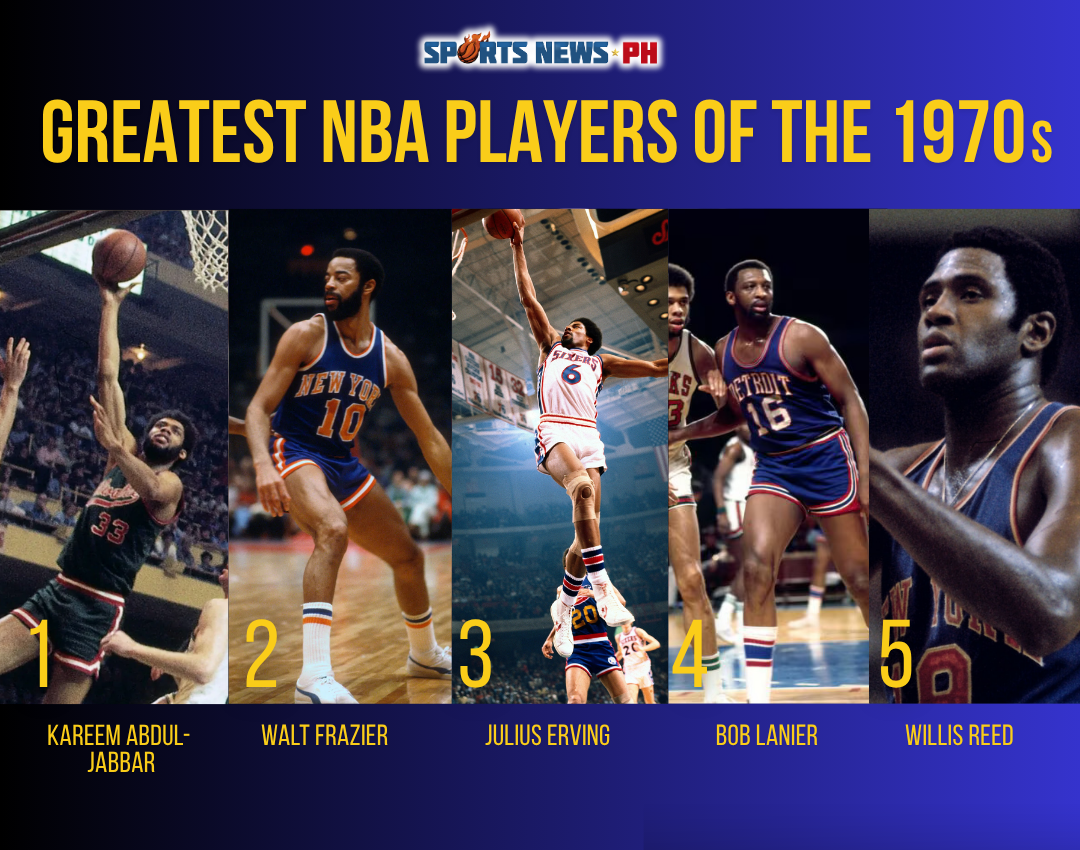
Here are the 5 greatest NBA players in the 1970s:
- Willis Reed
Few players in NBA history embodied toughness, leadership, and resolve like Willis Reed. As the emotional anchor of the New York Knicks’ golden era, Reed set the tone for a franchise built on selflessness, defense, and unshakable chemistry. His scoring touch in the post, dominant rebounding, and commanding presence in the paint made him one of the most complete big men of the decade.
Reed’s legacy is forever cemented by one of the most iconic moments in NBA history: limping onto the Madison Square Garden floor in Game 7 of the 1970 NBA Finals despite a severe leg injury. With the crowd erupting and his teammates instantly energized, Reed knocked down two early jumpers that turned the building electric and shifted the momentum of the entire series. The Knicks rode that spark to a championship, and Reed’s courage became a symbol of the decade itself.. A two-time champion, Finals MVP, and league MVP, he was the emotional core of a team and a city, earning his place among the defining stars of the 1970s.
- Bob Lanier
Bob Lanier was one of the most gifted big men of the 1970s, a player whose combination of finesse, power, and touch made him nearly unstoppable on the block. Standing 6-foot-11 with massive hands and remarkable mobility, Lanier anchored the Detroit Pistons through a decade of battles in one of the league’s most physical eras. His scoring arsenal was among the best of any center of his time: soft mid-range touch, bruising post moves, and a left hook shot that defenders struggled to contest. Night after night, Lanier delivered elite production, averaging well over 20 points and 10 rebounds per game throughout the decade, establishing himself as one of the premier frontcourt forces in the NBA.
But Lanier was more than a stat-sheet titan. He was the steady presence who kept the Pistons competitive during turbulent seasons. He battled through injuries, punishing defenses while absorbing constant physical play, and still found ways to elevate his team. His eight All-Star selections in the ’70s stand as a testament to his consistency and impact, even as the Pistons cycled through rebuilding years. Though he never captured a championship, Lanier’s skill, toughness, and longevity made him one of the decade’s defining centers, a player whose greatness was recognized every time he stepped on the court.
- Julius Erving
Before he ever stepped foot onto an NBA court, Julius Erving was already a phenomenon—an athlete whose style, swagger, and gravity-defying plays transformed the sport itself. During the 1970s, Erving became the face of the ABA and the living highlight reel who blurred the line between basketball and art. His soaring dunks, acrobatic finishes, and balletic movement through the air gave the game a new dimension, captivating fans and inspiring an entire generation of future stars.
Erving’s impact went far beyond the spectacle. He brought substance with the style as an elite scorer, versatile defender, and fierce competitor who carried the New York Nets to two ABA championships during the decade. His 1976 performance in the final ABA season, highlighted by the iconic “Baseline Move” in the Finals, cemented his place as a legend before he ever joined the NBA. When the leagues merged, Erving elevated the standard of play, proving that his brilliance transcended leagues, rules, and eras. By the end of the 1970s, Julius Erving was the symbol of basketball’s evolution, the bridge between the rugged past and the soaring future.
- Walt Frazier
Walt “Clyde” Frazier was the embodiment of style and substance in the 1970s. A floor general whose poise, defense, and playmaking made him the engine of the New York Knicks’ championship success. Frazier orchestrated the offense with a calmness that belied the pressure of the decade’s biggest moments. But his true brilliance shined on defense, where he became one of the greatest perimeter stoppers the game has ever seen.
No performance captures his greatness better than Game 7 of the 1970 NBA Finals. While Reed provided the emotional spark by taking the floor injured, it was Frazier who delivered one of the most dominant performances in Finals history. His 36 points and 19 assists remain one of the most complete Game 7 efforts ever recorded.. Throughout the decade, Frazier was the steady heartbeat of a Knicks team built on unselfishness and grit. A seven-time All-Star, perennial All-Defensive selection, and one of the most influential guards of his era.
- Kareem Abdul-Jabbar
No player defined the 1970s quite like Kareem Abdul-Jabbar. From the moment he entered the league, he became the decade’s most dominant and consistent force. His signature skyhook, a shot both graceful and devastating, became the most unstoppable weapon in basketball history, gliding over outstretched hands with mechanical precision. Throughout the decade, Kareem collected MVP awards at a staggering pace, winning five in the 1970s alone, cementing his place as the most decorated player of the era.
Abdul-Jabbar was a complete cornerstone. His rebounding, shot-blocking, and defensive presence anchored every team he played for, first lifting the Milwaukee Bucks to their first NBA championship in 1971 and later transforming the Los Angeles Lakers into an instant contender. In Milwaukee, he led the Bucks to one of the most dominant playoff runs ever seen, losing just two games en route to the title.
By the end of the 1970s, Abdul-Jabbar stood not only as the greatest player of the decade but as the figure who shaped the NBA’s competitive landscape. His combination of longevity, efficiency, dominance, and innovation made him the undisputed king of the ’70s.
OKBET is Asia’s most trusted and popular online sports gaming platform. Visit us on OKBET to stay up to date with all sports news from around the world.
👉 Don’t miss out on the latest sports news, updates, and fan discussions!
📌 Follow our Facebook page Sports News PH today and join the community of passionate basketball fans.










Related Posts
Stay Informed With the Latest & Most Important News
Previous Post
Next Post