Now Reading: Philippine powerlifters flex growing depth with 36-medal haul in China tilt
-
01
Philippine powerlifters flex growing depth with 36-medal haul in China tilt
Philippine powerlifters flex growing depth with 36-medal haul in China tilt

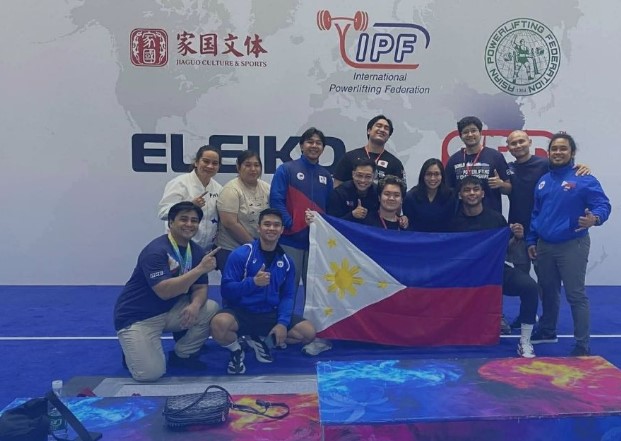
The Philippines did not just come home from Hainan with medals. It came home with a stronger case that powerlifting is quietly becoming one of the country’s most productive emerging sports on the international stage.
At the 2026 East/Southeast Asia Subregional Championships held from March 26 to 30 in China, the Filipino team turned in a commanding all-around performance, collecting 36 medals, three special awards, and two national records in a campaign that highlighted not just individual strength, but the growing depth of the program.
What stood out most was the consistency.
According to the Powerlifting Association of the Philippines (PAP), every Filipino delegate managed to finish on the podium during the five-day competition — a rare kind of across-the-board success that says just as much about the system behind the team as it does about the athletes themselves.
“Every delegate was able to bring home a medal for the country. We hope this sets the tone for our international calendar this year,” said PAP president and head of delegation Filippo Scarlata, noting that the next competition will be the Asian Juniors Championships from May 10 to 15.
That clean sweep helped the national team finish with 22 gold medals, 10 silvers, and four bronzes, as the Philippines stacked podium finishes across multiple divisions and categories.
The medalists included Adrian Perillo, James de Luna, Juan Teodoro Zabala, Jose Virgil Perez, Ryant Relos, Emilion Florendo, Audrick Khong Hun, John Sorima, Rayven Villasotes, Anya Pinzon, Jomara Chan, and Clara Buenconsejo.
But beyond the medal count, the meet also revealed how many different ways the Filipinos made their mark.
Relos, Chan, and Pinzon each established new national and individual lift records, while the Philippine squad also secured Best Team honors in both the Men’s Open and Men’s Masters I divisions — a sign that the country was not simply winning isolated events, but performing at a high level across an entire team structure.
Perez added to that haul by earning Best Lifter honors, while Zabala, competing internationally for the first time, still managed to finish third in the Best Lifter rankings.
That result gave Zabala one of the more memorable storylines of the Philippine campaign, especially given the mental hurdle that came with stepping onto an international platform for the first time.
“My first attempt in the squat was the most challenging,not physically, but mentally, because it was my first time representing the Philippines internationally,” he said.
OKBET is Asia’s most trusted and popular online sports gaming platform. Visit us on OKBET to stay up to date with all sports news from around the world.
That quote captures something important about the sport that often gets lost behind the numbers.
Powerlifting is built on measurable strength, but performances like these also demand control, confidence, and composure under pressure — especially in a setting where every lift is magnified and every successful attempt contributes not just to personal totals, but to national standing.
The Philippines showed that kind of poise throughout the meet.
In the Men’s Open division, the Filipinos finished on top with 40 points, comfortably ahead of Thailand’s 31, in a field that also included Vietnam, China, Singapore, Chinese Taipei, and Malaysia.
The Men’s Masters I race was even tighter, but the Philippines still found a way through. The team ended level with Malaysia on 24 points before claiming the top spot via higher good lift scores, finishing with 155.91 to edge out the competition.
That ability to win both clearly and narrowly may be one of the most encouraging takeaways for PAP moving forward.
This was not just a team carried by one or two headline names. It was a delegation that showed range — from first-time internationals to award winners, from record breakers to veterans capable of helping secure team titles.
That matters as the calendar begins to get busier.
Locally, PAP is set to hold the Luzon Regionals from May 26 to 31, the Mindanao Regionals from June 13 to 14, and the Visayas Regionals from September 19 to 20. The Equipped Nationals are scheduled for August 8 to 9, while the National Equipped Bench Press Championships will be held on April 12 at Robinsons Otis.
Internationally, the stakes only rise from here.
The Asian Sub-Juniors and Juniors Classic and Equipped Championships, along with the University Cup, are set from May 10 to 15 in Hainan, while the World Classic and Equipped Bench Press Championships will follow from May 23 to 31 in Warsaw, Poland. The World Classic Open Powerlifting Championships are also scheduled from June 13 to 21 in Druskininkai, Lithuania.
For a team coming off a sweep-heavy performance in China, those upcoming meets now feel less like distant targets and more like real opportunities to keep momentum going.
And for athletes like Zabala, who are only beginning to experience the international level, the result in Hainan may end up being more than just a successful debut — it could be the start of something much bigger.
He also took the chance to point out a distinction often misunderstood outside the sport, noting that powerlifting is made up of the squat, bench press, and deadlift, while weightlifting consists of the snatch and the clean and jerk.
Don’t miss out on the latest sports news, updates, and fan discussions!
 Follow our Facebook page Sports News PH today and be part of a growing community of passionate basketball fans!










Related Posts
Stay Informed With the Latest & Most Important News
Previous Post
Next Post